
Artikel: World Cup 2026 – How to Collect Icon Jerseys
World Cup 2026 – How to Collect Icon Jerseys
On June 11, 2026, the ball will kick off in the biggest World Cup ever played. 48 teams, 16 stadiums, and three countries: USA, Canada, and Mexico, a championship that is historic in its construction, with more teams, more venues, and more nations involved in hosting than ever before. Sweden has qualified and been placed in Group F, along with the Netherlands, Japan, and Tunisia, with matches in Monterrey, Houston, and Dallas. But every time a World Cup starts, something more than just football happens: a new generation of jersey collectors is born.
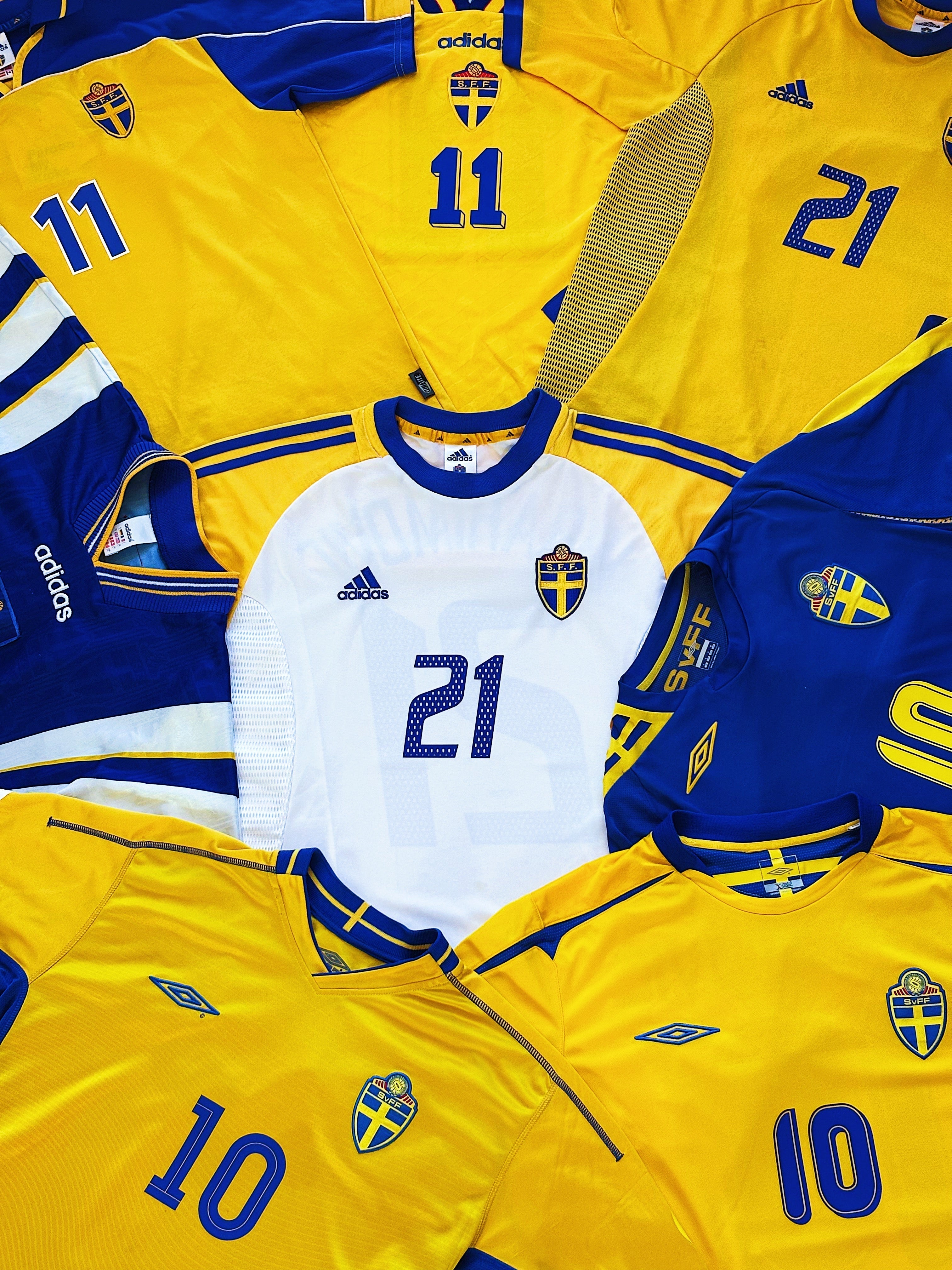
The nostalgia from 1998, 2002, and 2010 is already driving a growing market value for vintage World Cup jerseys, and when 2026 concludes, it will produce its own iconic garments, just as every major championship has done before it. Archives like Pardon My Kicks, specializing in authentic jerseys from great moments in football history, typically notice increased interest as a new World Cup approaches. This article explains why, and how you, as a collector, should think about it correctly.
The 2026 tournament in brief: what you need to know as a collector
The format that makes 2026 a historic World Cup
The 2026 World Cup is designed with 48 teams divided into 12 groups of four teams each. Each team plays three group stage matches, and a total of 32 teams advance to the knockout stage: the twelve group winners, the twelve group runners-up, and the eight best third-placed teams. The knockout tree then runs through round of thirty-two, round of sixteen, quarter-finals, and semi-finals, concluding with a bronze match on July 18 at Hard Rock Stadium in Miami and the final on July 19 at MetLife Stadium in East Rutherford, New Jersey.
For a collector, this format is interesting for a concrete reason: more teams mean more stars on big stages, and more stars mean more potential cult moments. The jerseys worn when an unexpected team reaches a semi-final, or when an unknown player delivers an unforgettable goal, tend to become future collector's items. With 48 nations and more matches than any previous World Cup, the probability of such moments increases significantly.
Sweden's path in Group F
Sweden faces Tunisia on June 15 at Estadio BBVA in Monterrey, the Netherlands on June 20 at NRG Stadium in Houston, and Japan on June 26 at AT&T Stadium in Dallas. Match times in Sweden are challenging due to the time difference: Sweden vs. Tunisia airs at 4:00 AM Swedish time on SVT, Netherlands vs. Sweden at 7:00 PM on TV4, and Japan vs. Sweden at 1:00 AM on SVT. See TV schedules for a complete overview. The full 2026 World Cup schedule is available at 2026 World Cup schedule for those who want to plan their sleepless nights.
Every time Sweden qualifies for a World Cup, a new collective memory is created. The jerseys worn during the tournament, regardless of the result, always end up becoming coveted artifacts for a generation that remembers exactly where they sat and watched.
How every World Cup births a new generation of jersey collectors
From 1998 to 2022: tournament moments that defined an era
Zidane's France in 1998 created a whole new interest in Adidas kits with tricolor details. The final jersey with Zidane's name and number is currently valued at around 100,000 euros for an authentic match-worn example, based on auction results from the last decade. Examples of the most valuable World Cup memorabilia sold show how far prices can go. Brazil's 2002 jersey, led by Ronaldinho and Ronaldo, is still one of the most sought-after vintage World Cup jerseys on the market. Spain's red collection from 2010, linked to Iniesta's decisive final goal, and Germany's fourth star in 2014 both attract football enthusiasts.
Mbappé's breakthrough in Russia 2018 and Messi's final match in Qatar 2022 each triggered a new generation of collectors. Messi's match-worn jerseys from 2022, sold as a set of six garments, reached a market value of around 7.8 million dollars. That is the extreme of what an iconic tournament moment can do to the value of a garment.
Why tournament nostalgia has an economic logic
The mechanism is predictable and well-tested: nostalgia is strongest 10 to 20 years after a World Cup, when the generation that grew up with the tournament begins to have economic purchasing power and seeks the physical memory of what they experienced. This is why 2006 jerseys are in a sweet spot in the market right now. Collectors who understand this cycle do not act reactively, they act proactively.
Tournament nostalgia acts as a value multiplier: it creates demand through memory and emotion, then supports higher prices through increasing scarcity of authentic examples in good condition. The jerseys that appreciate the most are always linked to historical performances, famous players, and visually distinctive designs.
The vintage World Cup jerseys collectors are chasing most right now
Which nations and players drive collector-driven searches
Argentina's 2022 jersey with Messi's name and number is already coveted and climbing in price. France 1998, Brazil 2002, Spain 2010, and Germany's 2014 collection all hold stable values on the secondary market.
For supporter versions of these jerseys, prices typically range from 50 to 300 dollars depending on condition and player. Match-worn or player-issued examples are in a completely different price segment. Jerseys with the player's name and number are consistently worth more than blank versions. A new and authentic Zidane 1998 with original tags differs dramatically in price.
At the same time, a major challenge with these collector jerseys is that there is a wide range of fakes on the secondary market. For the uninitiated who wants a genuine example, the mistake of buying a fake can be costly.
How to find authentic World Cup jerseys from previous generations
Where serious collectors look and what they avoid
Many large digital platforms are a minefield for anyone who doesn't already know exactly what an authentic garment looks like: provenance information is systematically missing, condition and price rarely correlate, and there is no functioning process for rejecting fakes. You can find what you're looking for there, but you take the risk home with you in the package.
Serious collectors look in specialized archives where jerseys are carefully authenticated before reaching sale.
See our latest blog post on How to buy an authentic vintage football jersey online.
Pardon My Kicks: the Swedish archive of World Cup history
At Pardon My Kicks, we sell authentic jerseys from the great eras of football history, including World Cup generations from the 1990s onwards. Each garment is hand-picked and the assortment is evaluated before publication. See a rare vintage example: Sweden 1998 Away Shirt
Our buy-sell-trade model also makes it possible to sell jerseys you no longer want, creating a circular collecting economy rather than one-way trade. Please contact us if you have football jerseys you want to sell.
Ahead of the 2026 World Cup: which jerseys from this year will become tomorrow's classics
How to identify an upcoming iconic kit
History shows a clear pattern for which World Cup jerseys actually hold their value over time. The team has a successful tournament. An individual player delivers a historic moment. The kit design is distinctive enough to remain visually appealing for many years. It is rare for all three criteria to be met, but every factor that applies strengthens the long-term collectible value, and this is a pattern that holds from the early 1980s to the present day.
During the 2026 World Cup, the signals are clear. A national team that reaches the semi-finals sees an immediate surge in the desirability of its jerseys, and that surge usually lasts. Look out for teams that perform beyond expectations, players who break through on the big stage for the first time, and designs that stand out visually in the group of 48.
Start your collection with the World Cup you remember best
The most sustainable advice for a new collector is also the simplest: start with the World Cup that has a personal connection. If you watched Spain 2010 or France 1998 and still remember exactly how it felt, start there. A collection driven by genuine memory and feeling is more sustainable than one based on speculation about future value.
This approach is also more credible. You already know what you're looking for, you understand why it matters, and you just need to find the right example. A typical vintage example that often captures the interest of novice collectors is Umbro - England 2002 Home Football Shirt 'OWEN'.
The 2026 World Cup is the start of the next generation of collectors
Every World Cup leaves behind an archive. The jerseys from 1998, 2002, and 2010 that drive the market today were once for sale at a lower price than they are worth now.
The jerseys worn in Monterrey, Houston, and Dallas during the summer of 2026 may well turn out to be the most sought-after garments from this era in ten years, if history repeats itself. But the nostalgia for the previous tournaments is already strong, and those jerseys are available today, for those who know where to look.
Whether you're collecting a specific World Cup, a team, or a player, an authentic kit is a physical memory of football history. Pardon My Kicks keeps that archive open.


Lämna en kommentar
Denna webbplats är skyddad av hCaptcha och hCaptchas integritetspolicy . Användarvillkor gäller.